Electrical & Computer Engineering (ECE) Curriculum Development
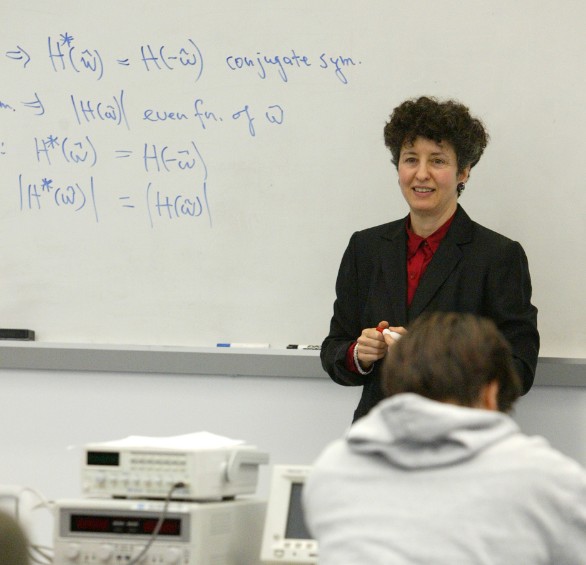
I created the first versions of ECE core courses at Olin, i.e., those required for the major: Signals and Systems, Digital Signal Processing, and Engineering System Analysis (the latter currently in development with Professors Chris Lee and Siddhartan Govindasamy). My ECE courses were necessary not only to educate our students, but also to ensure accreditation for our engineering programs. They comprised the signal processing part of Olin’s ECE portfolio submitted to ABET, the Accreditation Board for Engineering and Technology. As a new college, we applied in 2006 for our first accreditation review, a process that recurs every six years after initial accreditation. For Olin’s 2012 ABET accreditation process, I prepared the ABET documentation for Signals and Systems (a required course for the ECE degree). For Olin’s 2012 and 2018 ABET accreditation reviews, I prepared the ABET documentation for Digital Signal Processing (an either/or ECE requirement that can be taken with, or instead of, Analog and Digital Communication).
The ECE courses discussed below—Digital Signal Processing (DSP) and Signals & Systems—share certain attributes with my AHS offerings. Just as I develop a Composer’s Toolkit for students in Wired Ensemble, I give my ECE students a conceptual toolbox applicable to myriad engineering areas of interest. The concepts covered in DSP and Signals & Systems not only underpin the current tech revolution, but also our natural world. My courses peer under the hood of Matlab (a high-performance computing environment for engineers) and convey the reasoning behind numerous built-in commands that allow rapid analysis, design, and prototyping. Since mistakes can occur in computation, it’s fitting for engineers to understand the concepts behind built-in commands, regardless of programming environment, to discern whether the results of such functions, e.g., conv (convolving two discrete-time signals), make sense.
DSP and Signals & Systems are disciplinary in nature (electrical engineering), as shown in Map 2. The below discussions will demonstrate not only how these courses have helped develop Olin students—while Building & Sustaining the College (Map 1)—but also how they embody my three overarching themes of lifelong learning, intrinsic motivation, and the creative process (Map 3).
I. DIGITAL SIGNAL PROCESSING: 2009, 2010, 2011, 2012, (ON LEAVE SPRING 13), 2014, 2015, 2016 SPRING AND FALL, (ON LEAVE SPRING 18)
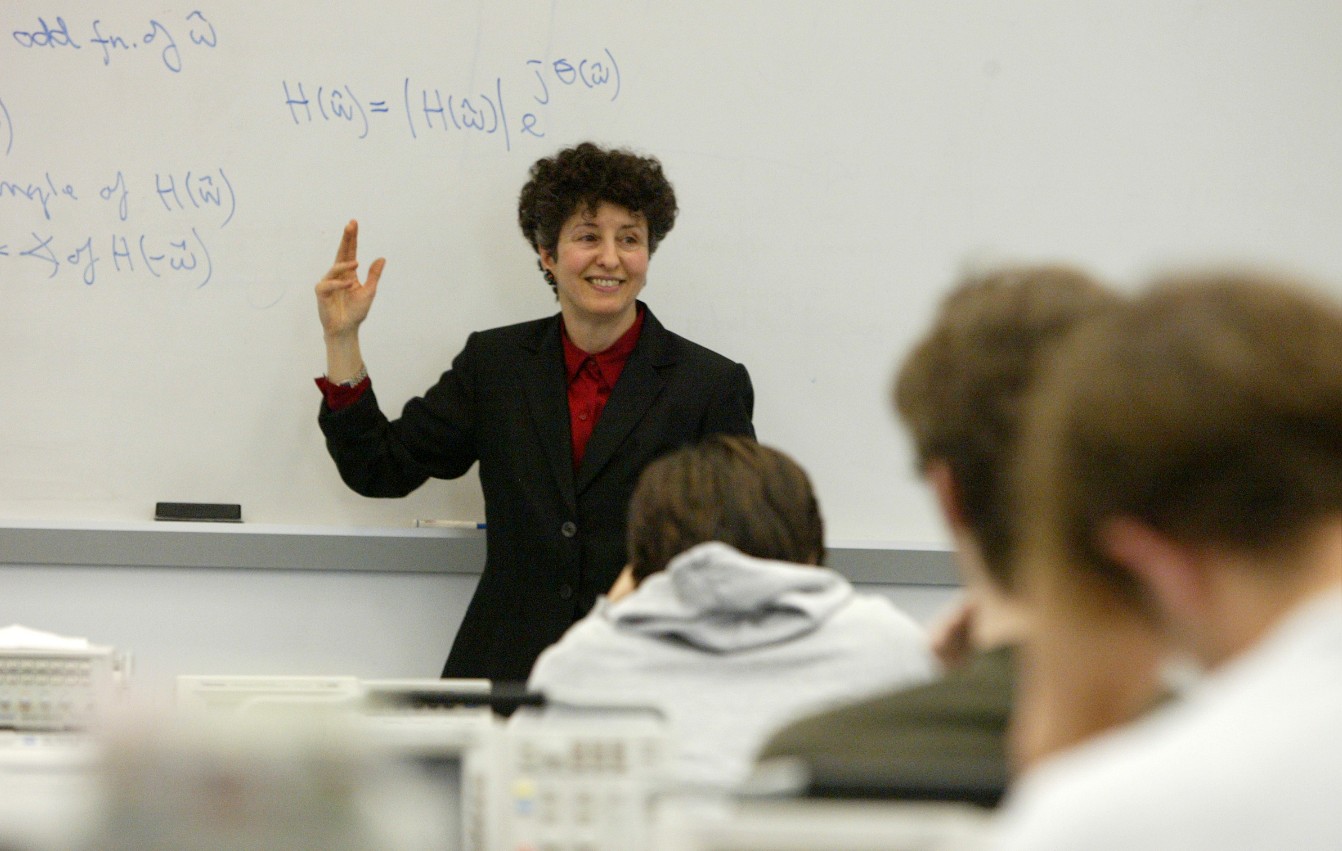
What’s special about DSP as taught at Olin?
- Starting the term with an advanced topic and pouring the syllabus out of it. We spend the first week examining an advanced topic (filter design) to motivate the ensuing course material. During that first week, most of the vocabulary and concepts associated with DSP are explained. Students can’t quite grasp it all, as expected, yet when they hear those terms/concepts again in weeks 2-13, their comprehension increases. Curiosity and motivation for learning perks up (intrinsic motivation). We use Matlab to explore filter design during that first week and throughout the term. By end of term, students understand much of what’s under the hood of Matlab’s signal processing commands.
- Flipping the classroom. During the 2014, 2015, and 2016 iterations of the course, I used a flipped classroom approach. I created, and subsequently revised, 48 handouts that outlined the key concepts. I connected them to earlier material and gave illustrative examples that students were able to complete at their own pace. The worksheets fostered self-teaching (lifelong learning). I spent much of the class time circulating among the students, answering questions.
National Instruments Academic Field Engineer Leslie Yu, DSP course assistants, and I developed a series of labs over the course of the DSP iterations that allowed students to work at their own pace and receive individual help. The first two labs were modeled on the DSP First Labs by McClellan, Schafer, and Yoder. After that, we developed Lab 3 (FIR Filters and Frequency Response), Lab 4 (Filter Implementation and Coefficient Quantization), and Lab 5 (Filter Structures) specifically for our Olin course.
- Integrating features of Wired Ensemble into DSP: intrinsic motivation, the creative process, including stimulation/impetus, preparation/scaffolding, application, feedback, revision, and effective communication. Interestingly, the Wired Ensemble influenced much of how DSP evolved. Like Wired Ensemble, DSP focuses on theory and practice, as well as building a professional vocabulary.
Preparation/scaffolding is provided not only for Final Projects but also for midterm and final exams. For example, weekly quizzes ensure students stay up-to-date with the course material.
To encourage intrinsic motivation, I give DSP students a long rope with respect to their Final Projects. But I also provide scaffolding in class and individual meetings. For example, for the first half of the term, we have weekly “Application Presentations and Reports” where students research and then prepare a DSP application of interest. Each student gives two application presentations and prepares a short written report on each. Both the presentation slides and the written reports comprise an ever-growing “Book of Apps” that students can access. In fact, many of these application presentations trigger final project ideas (stimulation/impetus).
However, because no rubric existed for either presentation or report, I decided to port over another feature of Wired Ensemble: writing according to a well-defined and professional rubric. I worked with Olin Writing Consultant Dr. Gillian Epstein to develop a rubric for the DSP “Application Presentations and Written Reports.” The rubric helped calibrate the students.
Next, I extended the Application rubric to DSP’s “Final Project Presentations and Written Reports.” In effect, the research and preparation of the Application Presentations and Written Reports provided the scaffolding for students’ Final Project deliverables which include a project proposal, revised project proposal, written final project report, and final project oral presentation (effective written and oral communication + revision). I provide written feedback on student project proposals and their revisions. I also arranged individual meetings (feedback) to help calibrate each student and allow individual questions.
In sum, as a disciplinary ECE course, DSP develops students through three overarching themes: lifelong learning, intrinsic motivation, and the creative process (stimulation/impetus, preparation/scaffolding, applications, feedback, revision, and effective communication). As part of the ECE core curriculum, it has helped build & sustain the college, contributing to the ABET accreditation process.
Please see the following Supplementary Materials: Fall 2016 course schedule, example course material, and a listing of topics delivered by 48 course materials I developed for DSP students, based on the last iteration of this course.
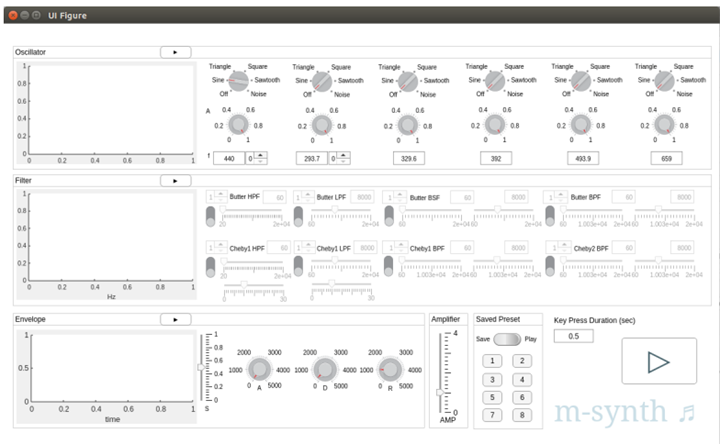
This document contains examples of DSP assignments, labs, and student work, including a student’s final project, M-synth.
Graphical interface built for M-synth, a final project in DSP.
II. SIGNALS AND SYSTEMS: 2003, 2004, 2005, 2006, 2007, (ON LEAVE SPRING 2008), 2012, 2019
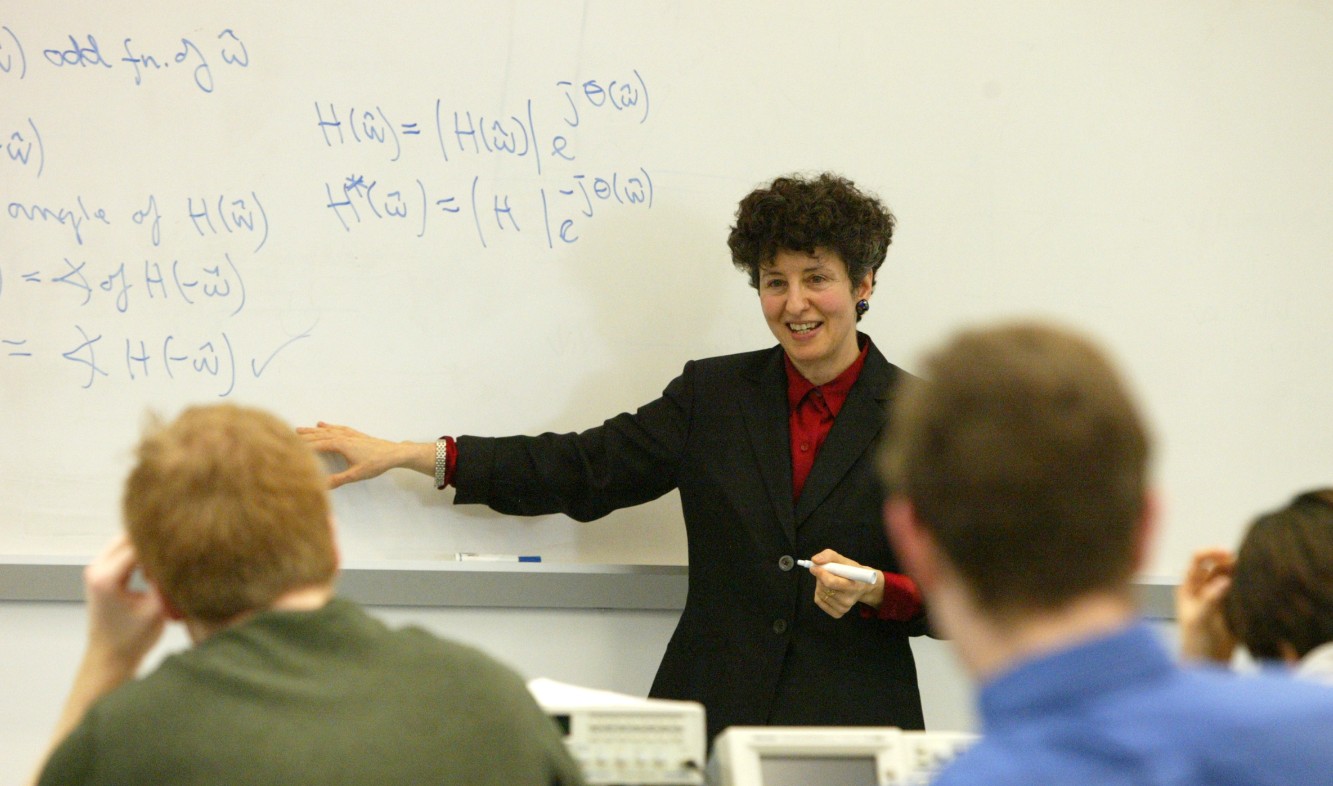
What’s different about the 2012 and 2019 editions of Signals and Systems? In addition to engineering content, they addressed written communication according to a professional rubric, required revision of written material, and encouraged students to explore applications that pique their curiosity. For the 2012 version of Signals and Systems, I completely re-vamped the course to achieve a fresh perspective. Since its topics pervade contemporary applications, I offered opportunities for research and a final project (lifelong learning, stimulation/impetus, and application). As with DSP, I wanted to provide preparation/scaffolding for the Final Project by giving each student a chance to research and present an application that captured interest. To foster intrinsic motivation, I brought over elements of Digital Signal Processing and Wired Ensemble, such as giving students a “long rope” (lifelong learning). Thus, they had free reign to present any application that employed signals and/or systems, which meant basically everything!
Having 26 students in the class afforded opportunities to learn from one another (lifelong learning) about 26 different applications pertaining to our course material. Furthermore, by virtue of finding an application to present, each student researched several applications, engaging an exploratory process that included self-teaching (lifelong learning), often leading to a Final Project idea, just as it had in DSP.
Yet another feature of DSP and Wired Ensemble—writing according to well-defined and professional guidelines—informed the 2012 Signals and Systems. I prepared “Guidelines for Signals and Systems Application Presentations and Written Reports”, including rubrics for the written application report and the oral presentation, based on the earlier DSP models. This assignment demonstrated our class emphasis on (1) application, (2) written communication, and (3) preparation/scaffolding for the students’ final project deliverables, including a final project proposal, final project demo, and written final project report and oral presentation (application). As with DSP, the application presentations and reports helped calibrate students: they heard/viewed their peers’ presentations, read peer application written reports (all of them accessible), and received written feedback from me. I also met individually with each presenter to give oral feedback and answer any questions.
To further calibrate the students, I gave an example presentation in class and wrote an example report that demonstrated the guidelines and rubrics (additional scaffolding).
Having gained experience and new knowledge with the Application Presentations and Reports, students were now prepared to produce their final projects. First they wrote Project Proposals according to prepared guidelines. I then provided written and oral feedback to each team of students using another feature of Wired Ensemble and DSP—individual sessions—so that they could then revise their proposals, and if desired, their projects.
The goals for the Signals and Systems final project included:
- Lifelong learning (students had to teach themselves material related to their projects)
- Intrinsic motivation (students selected their own project topics and deliverables, in consultation with me to ensure the projects were realizable in the time allocated)
- Effective written and oral communication
- Power of the revision process (students revised their Project Proposals, resubmitted, and received written and oral instructor feedback on their original and revised proposals via individual meetings)
- Stimulation/impetus (the joy of bringing an inventive work to fruition)
- Participation by each team member (every student on a given team had to present part of the project during the class presentations)
In sum, as a disciplinary ECE course, Signals and Systems develops students by means of three overarching themes: lifelong learning, intrinsic motivation, and the creative process (encompassing stimulation/impetus, preparation/scaffolding, application, feedback, review, and effective communication). Like the DSP course, it’s part of the ECE core curriculum requirements for the major; as such, it has helped build & sustain the college, contributing to the ABET accreditation process as well.
The following Supplementary Materials may be helpful: 2019 course schedule, example day assignment and correlating rubric , list of topics covered, and example homework.
III. ENGINEERING SYSTEM ANALYSIS
Engineering Systems Analysis (ESA) involves building, developing, and practicing process-based quantitative analysis skills in the broad area comprising linear analysis of engineering systems. During the first half of the semester, all engineering students take ESA:Systems. During the second half, mechanical engineers enroll in ESA:Dynamics, and electrical engineers enroll in ESA:Signals.
ESA:Systems focuses on concepts pertinent to both electrical and mechanical engineering, e.g., linearization, equilibrium, and stability inform the dynamic response of electrical and mechanical systems in both the time and frequency domains through time-integration and Laplace Transform analysis. Fundamentals of feedback control are introduced. The ESA:Systems project involves parameter identification and control of an unstable mechatronic system—an inverted pendulum on a translating cart.
Olin’s rationale for ESA: Linear system theory and feedback control are commonly included in the curricula of both Mechanical and Electrical and Computer Engineering programs. Both majors typically offer these subjects in similar, yet separate courses. ESA successfully integrates two subject-matter, specific content courses, Signals and Systems (ECE) and Dynamics (ME), into a single course that focuses on the development and application of general mathematical modeling and analysis tools to support the engineering design process. The efficacy and advantages of concept integration help build a shared language applicable to future academic projects and professional practice. Taught in a studio-setting, ESA serves as a prerequisite for advanced courses in either major.
ESA:Systems was first developed and taught by Professors Christoper Lee, Siddhartan Govindasamy, and Diana Dabby. Chris and I offered the next two iterations (2021, 2022), followed by Chris, Prof. Mark Somerville, and Prof. Chhavi Goenka in 2023, and Visiting Prof. Orion Taylor and Diana Dabby in 2024.
Find useful Supplementary Materials here: 2021 ASEE publication, homework example, sample material, and sample schedule.