140+ Orchestral Arrangements for 10-22 Players
 This document—organized by academic year—gives
orchestral arrangements that can be accessed at The Engineers’
Conductorless Orchestra Hub, a website offering useful resources,
videos, orchestral arrangements, and blueprints to help/encourage other
engineering schools to start their own conductorless orchestras, as
discussed throughout this page.
This document—organized by academic year—gives
orchestral arrangements that can be accessed at The Engineers’
Conductorless Orchestra Hub, a website offering useful resources,
videos, orchestral arrangements, and blueprints to help/encourage other
engineering schools to start their own conductorless orchestras, as
discussed throughout this page.
Students in the Olin Conductorless Orchestra (OCO) select their own repertoire. In general, they favor big romantic pieces typically played by 70+ musicians (~50 strings and 24 wind/brass/percussion). But Olin has a small student body which has resulted in nontraditional instrumentation since OCO’s inception in Fall 2002. This means every piece must be re-orchestrated to suit each semester’s available instruments. For example, OCO winds and brass can outnumber the strings, and vice versa, so balance has to be achieved through often unorthodox means.
My 140+ arrangements have enabled a small school like Olin to have an orchestra, despite OCO’s eclectic instrumentation. They can also help other engineering schools form their own orchestras since these schools will likely lack a full complement of standard instruments comprising their string, wind, and brass sections. The arrangements are portable to other engineering schools via the Engineers’ Conductorless Orchestra website Hub, an externally-facing site with the mission of helping others outside the Olin community actualize the conductorless orchestra model.
Explanatory notes for the OCO re-orchestrations (arrangements of symphonic works). In creating these arrangements, I strive to make OCO sound as full and varied as possible, with a wide dynamic range, different colorations, strategic doublings, and effective solos/duets. Yet constraints exist, e.g., the comfort ranges of the OCO musicians. Simply substituting one instrument isn’t an option: given the eclectic instrumentation of the last 22 years, a great group sound has to be created by imaginative voice leading, unorthodox doubling (e.g., violins with glockenspiel), timbral sleight-of-hand (e.g., blending a tenor sax into an 18th century symphony), and other means.
Here is a short summary of my process for creating orchestral arrangements for the Olin Conductorless Orchestra. (The specific re-orchestrations mentioned below are elaborated further in this document).
- At the start of each semester I ask students for their comfortable high and low forte notes and high/low piano notes. These often dictate what I can and cannot do, resulting in re-orchestrations particular to student instrumentalists. This is one of the reasons why my arrangements may be useful to other engineering schools wishing to start their own conductorless orchestras.
- Instrumental, sectional (strings, winds, brass, percussion), and orchestral voice leading. For example, taking a high passage written for the violins and moving it down an octave, which often necessitates moving other string and wind parts down an octave, then bringing them back into their intended ranges in a smooth manner with good voice leading.
- Stylistic intent of the composer. Having performed many Haydn, Mozart, and Beethoven piano sonatas, as well as myriad romantic works, I’ve assimilated a wide array of styles. For example, I created an arrangement of Haydn’s Symphony No. 48 (first movement) that evoked the classic style through an artful blend of three clarinets, two flutes, and a tenor sax with strings, instead of Haydn’s wind section of two oboes and a bassoon.
- Contrapuntal and harmonic practice of the composer, e.g., for a piece in E minor, replacing the low B1 dominant of the double basses with B2 (since we have no double basses), but approaching the B2 in a stylistically smooth manner, as occurs multiple times in my arrangement of the Dvorak Ninth.
- Nontraditional instrumentation, i.e., instruments typically not found in an orchestra such as piano and saxophone (e.g., my arrangement of the Berlioz “Marche Hongroise”), an over-abundance of clarinets—or none at all—as can be heard in my arrangements of Haydn’s Symphony No. 48 and Gershwin’s An American in Paris, respectively. Frequently I’ll compensate an over-abundance of a given instrument (such as flute) by combining each of the ‘too many flutes’ with other instruments to create hybrid instruments that hide the recognizable flute timbre (as I did with An American in Paris). At other times, I’ll score the non-traditional instrument (e.g., tenor sax) in a register where it will blend best with the other instruments to create a coherent group sound (as with Haydn’s Symphony No. 48).
- Non-standard ratios of violins, violas, and cellos. Strings characteristically present a homogeneous section which helps when there isn’t enough of a given instrument. But what happens when OCO has six violins and only one cello (as occurred in Spring 2019)? Depending on context, I doubled the cello with alto sax and/or brass, and even with violins, as can be heard in the Berlioz “Marche Hongroise.”
- Non-standard ratios of winds and brass. As an example, Mozart wrote his Wind Serenade, K. 361, for 2 oboes, 2 clarinets, 2 basset horns, 4 horns, 2 bassoons, and double bass. But during Spring 2019, OCO had none of these instruments; instead, we had 3 flutes, an alto sax, trumpet, euphonium, and trombone. I created an arrangement for these instruments, and wrote extra parts for our pianist and timpanist so they could join the section.
- Untenable writing for too few instruments, e.g., the Dvorak Eighth with only three violins to sustain stratospheric writing intended for a full first violin section. As another example, in his Ninth Symphony Dvorak wrote climactic passages that take the first violin section—typically 16–18 players—ever higher. But in Spring 2016, OCO only had six violins. Though some of the OCO violinists could technically play these parts, the results would have been thin and anticlimactic in comparison with the intended large violin section of the orchestra which gave its 1893 world première (Philharmonic Society of New York). So to achieve these climactic passages, I scored the stratospheric lines for both glockenspiel and piano (right hand in octaves), doubled at the octave below by all six violins so that their overtones would support the glockenspiel (a high bell-like instrument) and piano.
- Giving students solos, as can be heard in all the OCO YouTube recordings. For example, in An American in Paris, I often re-distributed solos, originally written for one instrument, among several players. I frequently give the recapitulation of a solo to another member of the orchestra, or re-allocate who gets the top line, e.g., flute1 and flute2 customarily play the higher and lower flute parts, respectively, but I often switch them to provide more variety for the players, as can be heard in all my arrangements for OCO.
- Reduction from 90+ player orchestrations to 10-22 player arrangements (e.g., the 24 wind/brass instruments required for An American in Paris vs. the eight available in OCO ), or an increase in forces, as from a wind ensemble to a mixed wind/brass/percussion/piano ensemble (e.g., Mozart’s Serenade in Bb for Winds, K. 361).
- Balance issues, i.e., non-standard numbers of wind, brass, and strings comprising their respective sections, as have occurred and been addressed in all my arrangements, e.g., An American in Paris and Danzon No. 2 by Arturo Marquez, to name but two.
- Creating the impression of large forces through changes in dynamics, color contrasts, decreasing/increasing texture, among other strategies. OCO typically likes ‘big’ works, such as Danzon No. 2, the Dvorak Ninth Symphony, and An American in Paris, among others.
- I try to give each student a good part that speaks to his/her/their strengths, while also challenging weaker aspects of an individual’s playing (provided the student shows a commitment to mastering an earlier part). I also try to give each at least one challenging part so they can ‘rise to the occasion’, hopefully paving the way for additional challenging parts. When material is repeated, I’ll often vary the orchestration with each repetition (e.g., the Berlioz “Marche Hongroise”) or when duets/trios allow, I switch players in and out, thereby distributing parts (e.g., Gershwin’s American in Paris at rehearsal 67).
- And finally, something I always try to do: everyone plays at the end of a piece—at least one note!
This document examines eight of my orchestral arrangements, showing how I created stylistic consistency and a coherent group sound for OCO despite eclectic instrumentation and unbalanced wind, brass, and string sections. Access scores of these orchestral arrangements.
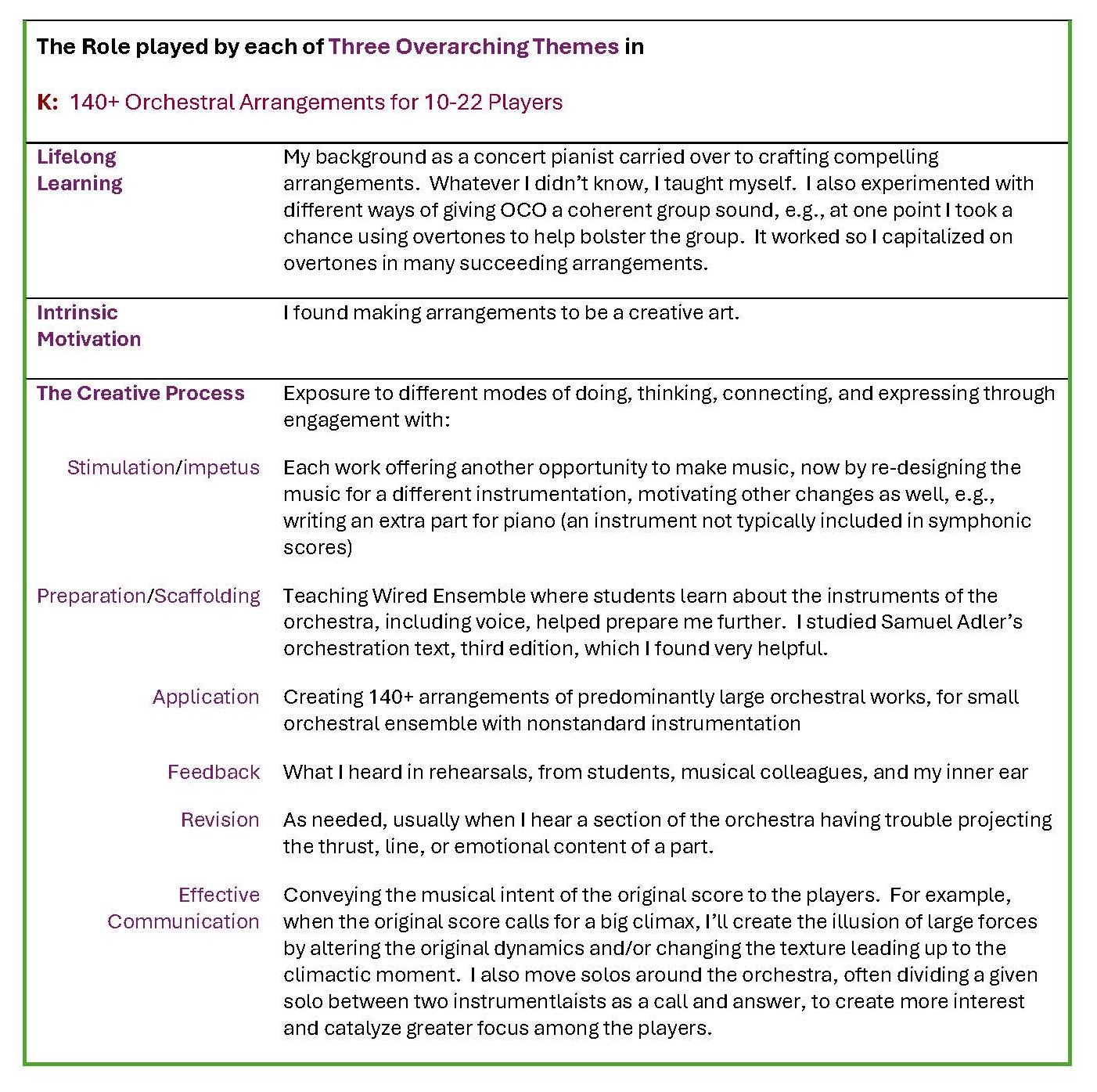
In sum, by creating orchestral arrangements for the Olin Conductorless Orchestra, I sought to not only establish its viability but also support goals of developing students, providing external impact, and building & sustaining the College (Map 1). These arrangements enabled our students and community to have an orchestra for the past 22 years—despite an eclectic array of instruments—an orchestra that has helped students grow, both as players and listeners; an orchestra that has had a positive impact on prospective students, their families, and wider communities outside Olin; an orchestra that by virtue of its being conductorless has contributed to Olin’s reputation for innovation in engineering education. Thus, though this project lies in the music space, it also inhabits the engineering space (Map 2). The table below captures the role played by each of my three overarching themes in producing these arrangements, thus elaborating upon Map 3.